Beyond the Scoreboard: How Games Shape Thinking, Culture, and Connection

What Makes a Game a Game?
At their core, games are structured experiences built from rules, goals, and feedback. Unlike free-form play, games define boundaries: what actions are allowed, what counts as success, and how progress is measured. Whether it’s capturing a flag, solving a puzzle, or managing a virtual city, games create meaningful choices inside a designed system.
Most games share a few common ingredients:
- Rules: Constraints that shape behavior and strategy.
- Goals: Clear outcomes such as winning, surviving, completing a narrative, or improving a score.
- Feedback: Signals like points, health bars, sounds, rankings, or story consequences.
- Voluntary participation: Players opt in, accepting the rules for the sake of the experience.
These elements can be combined in countless ways, which is why games can feel as different as chess and a cooperative story-driven role-playing game, yet still belong to the same medium.
A Brief Tour of Game Types
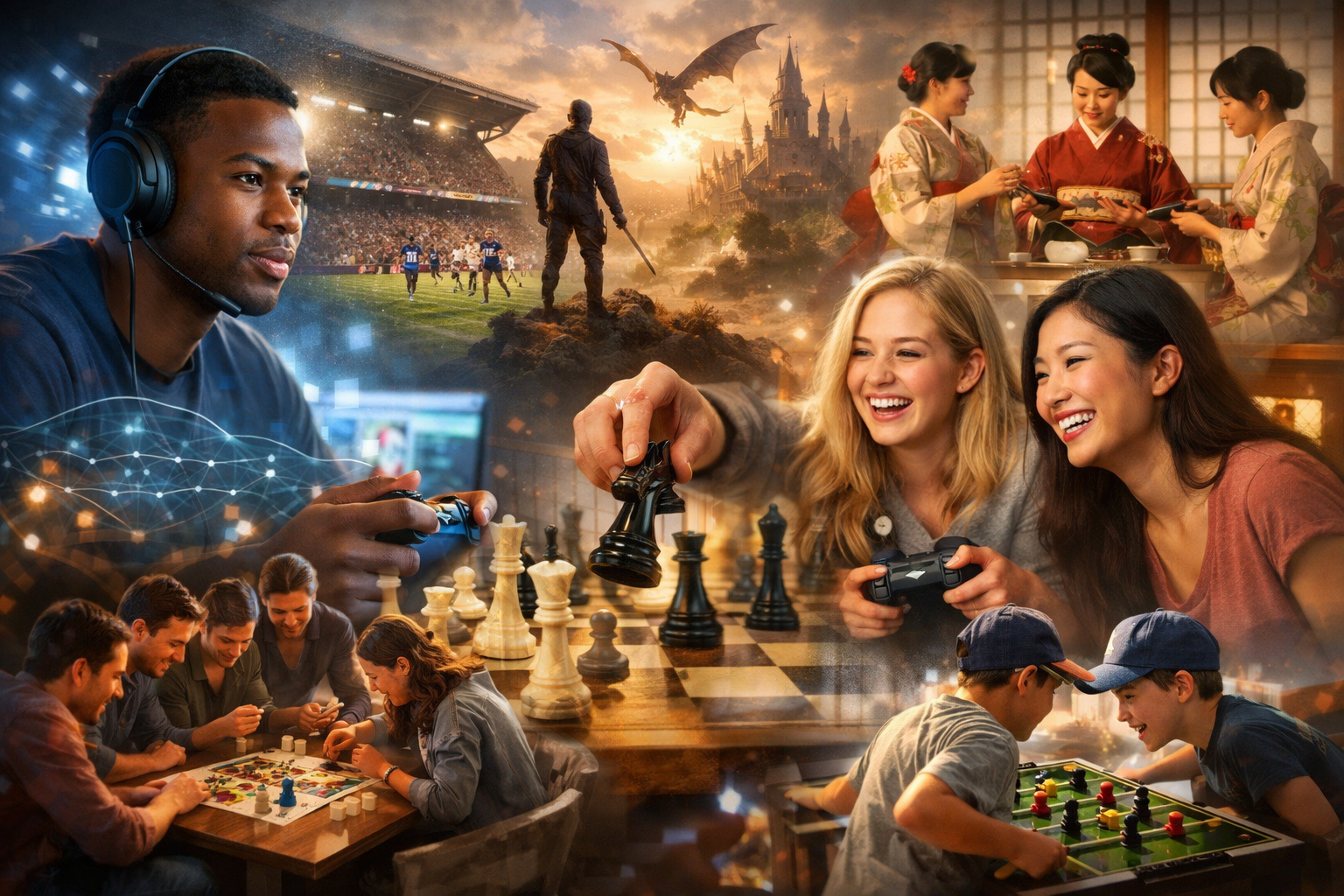
“Games” is an umbrella term covering many formats, each emphasizing different skills and pleasures. Understanding the major categories can help you find experiences that fit your mood, time, and preferred style of challenge.
Tabletop and Board Games
Board games, card games, and tabletop role-playing games (TTRPGs) create face-to-face interaction and shared problem-solving. Many modern board games focus on elegant design: tight rules, meaningful decisions, and minimal downtime. TTRPGs add improvisation and storytelling, where the “system” supports creativity rather than limiting it.
Video Games
Video games span action, strategy, simulation, sports, puzzle, adventure, and more. Their advantage is responsiveness: the computer can simulate complex worlds, track hidden information, and adapt to player choices. From a two-minute mobile run to a 100-hour epic, video games can be tuned for almost any attention span.
Sports and Physical Games
Physical games emphasize movement, teamwork, and embodied skill. The rule systems are often simple, but the gameplay is deep because humans bring unpredictability and nuance. Even casual backyard games can develop coordination, communication, and resilience.
Social and Party Games
Party games prioritize laughter, accessibility, and group energy. They often use short rounds, easy rules, and playful tension. The “win” can be secondary to bonding and shared memories, which is why these games thrive at gatherings.
Why Games Are So Engaging
Games are compelling because they turn effort into visible progress. Good games teach you as you play, giving you just enough information to improve while preserving uncertainty. This creates a loop: try, learn, adapt, and try again.
Several design patterns fuel this engagement:
- Challenge that scales: Difficulty can rise with your skill, keeping you in a zone where success feels earned.
- Meaningful choices: Different decisions lead to different outcomes, encouraging strategy and experimentation.
- Clear feedback: Immediate responses help players connect actions to results.
- Short-term and long-term goals: A quick objective keeps momentum, while bigger goals sustain motivation.
When these pieces align, games create a satisfying sense of agency—your decisions matter, and the system reacts in understandable ways.
Games as Tools for Learning and Skill-Building
Games can function as informal classrooms. Strategy games train planning, prioritization, and resource management. Puzzle games sharpen pattern recognition and logical reasoning. Cooperative games build communication, role clarity, and trust.
Even failure becomes useful in a game context: the cost is usually low, the lesson is clear, and the reset is quick. This encourages a “try again” mindset that can carry into real-world learning. Many educators and trainers use game-like structures—levels, quests, feedback loops—to make practice more engaging and measurable.
The Social Side: Community, Competition, and Cooperation
Games create social spaces with their own norms and rituals: Friday-night board game groups, online guilds, local sports leagues, and massive esports audiences. Competition can be thrilling, but cooperation is often the glue that keeps communities healthy.
In multiplayer environments, teamwork becomes a skill of its own. Players learn to share information, coordinate timing, and balance individual performance with group goals. Meanwhile, spectatorship adds another layer: watching skilled players can be entertaining and educational, helping others understand tactics and decision-making.
Culture, Storytelling, and Identity
Games are cultural artifacts. They reflect the values, humor, anxieties, and aesthetics of the people who create and play them. Some games focus on narrative, exploring themes like sacrifice, belonging, or moral ambiguity. Others tell stories through systems: a city builder might communicate ideas about scarcity and trade-offs without a single line of dialogue.
Players also bring identity into games—through avatars, playstyles, and community roles. Customization and representation matter because they influence who feels welcomed and seen. As the medium grows, so does the diversity of voices shaping what games can say and who they are for.
Healthy Play: Making Games Work for You
Because games can be absorbing, mindful habits help keep them enjoyable. Consider aligning your game choices with your goals: relaxation, social connection, creative expression, or skill improvement. It also helps to pay attention to how a game’s reward structure affects your time and mood.
- Set boundaries: Use timers or natural stopping points (a match, a chapter, a quest).
- Play with intent: Choose games that match your energy—calm puzzles for winding down, competitive play when you want intensity.
- Prioritize positive communities: Mute, block, or leave spaces that drain enjoyment.
- Mix formats: Balance solo games with social ones, and digital experiences with offline play.
The Future of Games
Games continue to evolve through new technologies and changing audiences. Cross-platform play, community-driven updates, and creative tools that let players build their own content are reshaping how games are made and sustained. Meanwhile, accessibility options—remappable controls, colorblind modes, difficulty tuning, text-to-speech—are expanding who can participate.
Yet the heart of gaming remains surprisingly constant: a well-designed set of rules that invites people to explore, compete, cooperate, and discover. As long as humans enjoy challenge and curiosity, games will keep finding new ways to bring us together—one decision, one turn, and one match at a time.

