Beyond the Bottom Line: How Modern Business Creates Value, Trust, and Resilience

What “Business” Really Means
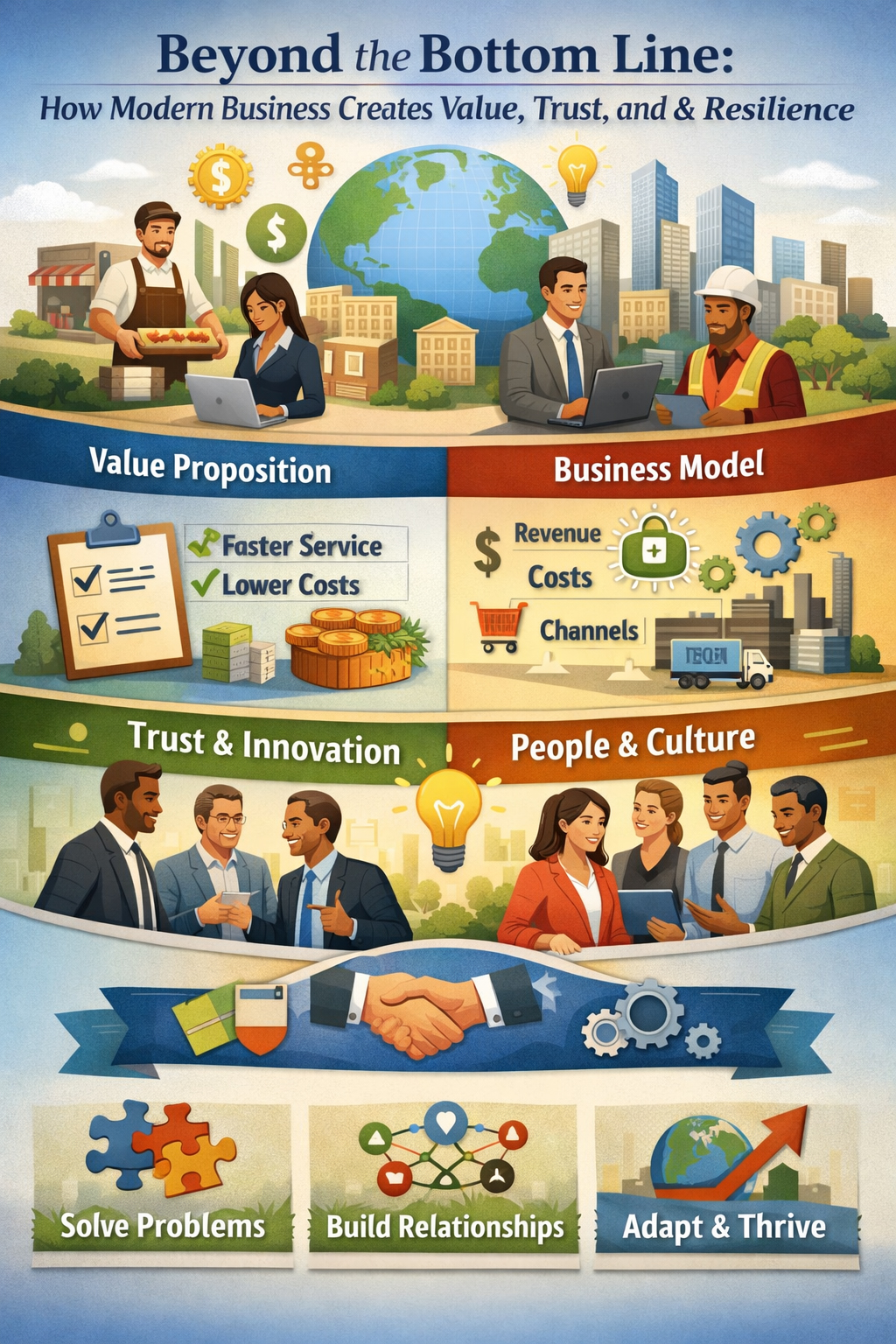
At its core, a business is an organized effort to create value for a defined group of customers while generating enough revenue to sustain operations and reward stakeholders. That value can be practical (saving time, reducing cost, improving health), emotional (status, belonging, security), or a blend of both. Whether it is a neighborhood bakery or a global software company, every business must answer the same foundational questions: Who do we serve? What problem do we solve? How do we deliver the solution reliably? And how do we earn more than we spend?
Modern business is not only an economic engine; it is also a social and technological system. It depends on trust, coordination, and the intelligent use of resources. When these elements align, businesses can innovate, create jobs, strengthen communities, and expand opportunity.
The Building Blocks of a Successful Business
While industries differ, high-performing businesses share a handful of common building blocks. Understanding them helps clarify why some organizations scale and endure while others stall.
1) A Clear Value Proposition
A value proposition is the reason customers choose one option over another. It should be specific, measurable, and relevant. A business that competes solely on vague claims (“best quality,” “great service”) often struggles because customers cannot easily verify the promise. Strong propositions are concrete: faster delivery, fewer errors, better outcomes, lower total cost, or a superior experience.
2) A Viable Business Model
A business model explains how value creation becomes value capture. It ties together pricing, costs, distribution, and customer relationships. Common models include subscription services, transaction fees, licensing, direct-to-consumer sales, marketplaces, and usage-based pricing. The “best” model depends on the customer’s buying habits and the economics of delivery.
- Revenue: How money comes in (price × volume, recurring vs. one-time, retention-driven vs. acquisition-driven).
- Costs: Fixed vs. variable costs, unit economics, and operational efficiency.
- Channels: How customers discover, evaluate, and purchase (retail, online, partners, sales teams).
- Moat: Why competitors cannot easily copy the advantage (brand, switching costs, network effects, patents, data, distribution).
3) Operations That Deliver Consistently
Operations are where strategy becomes reality. Even brilliant ideas fail when execution is unreliable. Strong operations focus on repeatability—documented processes, quality control, training, and feedback loops. Increasingly, businesses also measure operational health through metrics like cycle time, defect rate, on-time delivery, customer satisfaction, and employee engagement.
4) Financial Discipline
Finance is not just accounting; it is decision-making with constraints. Cash flow, margins, and working capital determine how long a business can invest before it must produce returns. Sustainable businesses know their key numbers: customer acquisition cost, lifetime value, gross margin, burn rate, and break-even point. They use budgets and forecasts not as rigid rules, but as tools to allocate resources where they have the highest impact.
Strategy: Choosing Where to Compete and How to Win
Strategy is the set of choices that make a business distinct. It clarifies the market segment, the positioning, and the capabilities the company will prioritize. Importantly, strategy involves trade-offs. Trying to be the cheapest, fastest, and most premium at once usually produces confusion, internal conflict, and inconsistent customer experiences.
A practical approach is to define:
- Target customer: Who benefits most, and who is not the priority?
- Primary problem: Which job are you hired to do?
- Competitive edge: What can you do better than others in a repeatable way?
- Focus metrics: Which outcomes define success (retention, profit per customer, market share, quality)?
People: The Hidden Infrastructure
Businesses run on talent, incentives, and culture. People systems determine whether teams coordinate effectively, innovate responsibly, and handle pressure. Hiring matters, but so do onboarding, role clarity, performance feedback, and leadership development. When employees understand how their work connects to customer value, they make better day-to-day decisions without constant supervision.
Culture is often misunderstood as perks or slogans. In practice, culture is the set of behaviors that get rewarded. If a company rewards speed without accountability, quality declines. If it rewards cost-cutting without customer focus, loyalty erodes. Strong cultures balance results with standards: they move quickly, but they also measure outcomes and learn from mistakes.
Marketing and Sales: Creating Demand and Building Relationships
Marketing is the discipline of understanding customers and shaping how the market perceives your offering. Sales is the process of guiding decisions and closing commitments. In many businesses, the boundary between them is blurred, especially online where customers research independently before talking to anyone.
Effective demand generation typically includes:
- Positioning: A clear message that differentiates you.
- Content and proof: Demonstrations, case studies, reviews, and transparent pricing or outcomes.
- Friction reduction: Easy trials, clear onboarding, and responsive support.
- Retention focus: Customer success, loyalty programs, and continuous improvement.
Innovation and Adaptation in a Changing World
Business environments evolve due to technology, regulation, customer expectations, and global events. Resilient organizations treat change as a permanent condition. They scan for signals early, run small experiments, and invest in capabilities that let them adapt—data literacy, automation, cybersecurity, flexible supply chains, and scenario planning.
Digital transformation is not merely adopting new software; it is redesigning workflows to reduce waste and improve customer experiences. Likewise, responsible business practices—ethical sourcing, transparent governance, and environmental stewardship—are increasingly tied to brand trust and risk management. Customers, employees, and investors now evaluate businesses not only on what they sell, but on how they operate.
What Sustainable Success Looks Like
A healthy business balances short-term performance with long-term durability. It builds products people want, earns profits that fund reinvestment, and maintains trust with employees, customers, partners, and communities. The most enduring organizations keep returning to first principles: create real value, deliver it consistently, measure what matters, and evolve before circumstances force change.

